

Vascular Surgeon
Expert in the treatment of varicose veins
Office work, remote working and venous circulation: what sitting all day really does to your legs
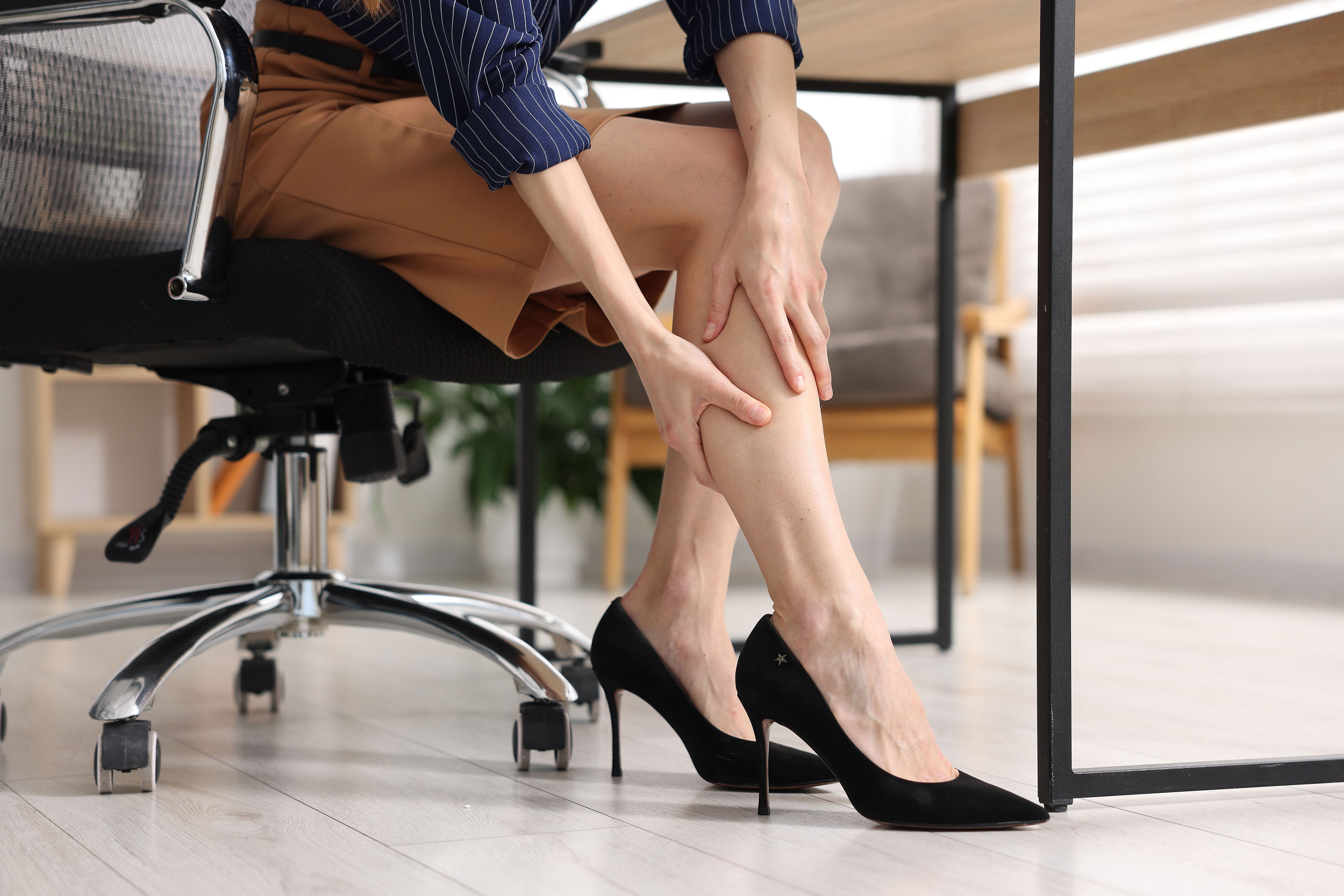
Heavy legs at the end of the day, ankles marked by your socks, a feeling of tightness in the calves: with the return to work after the summer, these symptoms often come back at the same time as the long days at a desk. Prolonged sitting is not harmless for venous circulation, but the problem is not the one most people imagine.
1. With the return to work, many of us are back at our desks and sitting for several hours a day. What impact can this have on venous circulation?
To understand it, we need to keep one simple fact in mind: in the legs, venous blood has to travel back up to the heart, against gravity. The heart pushes blood downwards, but it does not draw it back up.
Most of that upward work is done by the calf muscle pump. With every step, the calf muscles contract and compress the deep veins, which in turn draw on the superficial veins, propelling the blood upwards. The valves inside the veins then prevent it from flowing back down.
When you sit for several hours without moving, that pump is switched off. Blood pools in the legs, pressure builds inside the veins, and some of the fluid passes into the surrounding tissue. This is what we call oedema, and it is what produces the swollen ankle, the heavy-leg sensation and the sock marks at the end of the day.
The key point is that it is not sitting in itself that causes the problem: it is how long you sit without a break. Someone who sits for eight hours but gets up regularly is not in the same situation as someone who sits for four hours straight without ever moving.
2. When working from home, it is easy to spend several hours without even getting out of your chair. What mistakes should be avoided?
Working from home has removed everything that, at the office, used to make us move without thinking about it: the walk between two meeting rooms, the coffee machine, the colleague you go over to speak to. One video call follows another and you never really leave your seat.
The most common mistakes I see:
Working on the sofa or on the bed. On a bed or a sofa, you end up folding your legs under your own weight, which compresses the back of the thighs and the knees and restricts venous return further still.
- A badly adjusted chair. If your feet do not reach the floor, the edge of the seat presses into the back of your thighs and creates a permanent compression point. The lack of contact with the floor also prevents the ankle flexion and extension movements that help venous return.
- An overheated home. Heat dilates the veins. High heating, or underfloor heating beneath your desk, makes symptoms noticeably worse in winter.
- Drinking less. With no water cooler and no shared breaks, you think less about staying hydrated, when in fact it is an opportunity to get up.
3. Sitting for eight hours a day, or standing all day: which is harder on the legs?
This is the question I am asked most often, and I almost always give the same answer: it is a false choice. The two postures have one thing in common, and that is immobility.
Standing still is certainly the worse of the two. The column of blood between the foot and the heart is at its longest, and the pressure inside the veins of the ankle is at its highest. This is precisely why prolonged standing is recognised as an occupational risk factor for chronic venous disease, particularly among hairdressers, healthcare staff, shop assistants, catering staff and many other service occupations.
Sitting is slightly less unfavourable, because that column of blood is shorter. But hip and knee flexion come into play, along with the pressure of the seat against the back of the thighs, while the calf pump remains just as inactive.
In other words: prolonged standing is the more damaging of the two, but above all the worst posture is whichever one you hold the longest without moving. What protects the legs is alternating between positions, and walking.
4. At the office, how often should you ideally get up and walk? And does walking more in daily life really make a difference?
At a minimum, get up every two hours and walk for ten to fifteen minutes. This is not a token thirty-second break: the walk has to last long enough for the calf muscle pump to do real work and empty the veins.
And there is a second factor, at least as important and almost always overlooked: hydration. When you drink too little, the blood becomes more concentrated and more viscous, which further slows a circulation that is already hampered by immobility. Drinking regularly has a double benefit: it keeps the blood fluid, and it forces you to get up.
Walking and drinking are the two pillars of prevention when you have a sedentary job and spend the day sitting at a desk. They are also the two things you stop doing without noticing as soon as the workload increases.
Between breaks, if you really cannot leave your desk, work your ankles underneath it: around fifteen flexion and extension movements, rising onto your toes and then lifting your toes up. This is exactly why an office chair needs to be properly adjusted. It is the same movement recommended on a plane, and it activates the calf pump without having to stand up.
As for whether walking more really makes a difference, the answer is yes, unambiguously. One qualification is needed, however: walking will not make existing varicose veins disappear, because a vein whose valves no longer work cannot be repaired by exercise. It does, though, markedly reduce symptoms and helps to slow the progression of the disease.
5. Compression stockings: who are they really for, how should you choose them, and should you wear them at the office or only when travelling?
Let us start by clearing up the main misunderstanding: compression stockings are not reserved for long-haul flights. They are strongly recommended in that situation, but it is one that arises rarely for the vast majority of people. In practice, they are indicated whenever there is discomfort, venous symptoms, a known venous condition, or a job involving a prolonged static posture, whether sitting or standing. Wearing them at the office is therefore entirely appropriate.
How do they work?
They apply graduated pressure, strongest at the ankle and decreasing as it rises towards the calf. This pressure helps the veins to empty upwards and supports the work of the muscle pump.
The four compression classes
In France, pressure is measured at the ankle in accordance with the Afnor G30 102B standard, and four classes are distinguished:
- Class 1: 10 to 15 mmHg, light compression.
- Class 2: 15 to 20 mmHg, medium compression.
- Class 3: 20 to 36 mmHg, strong compression.
- Class 4: above 36 mmHg, very strong compression.
Classes 1 and 2 cover the great majority of cases involving prevention and heavy legs. The higher classes correspond to specific indications determined after examination. On medical prescription, these devices are reimbursed by the French health insurance system at 60% of the base rate.
How to choose them, and how to wear them
Two conditions have to be met for them to be effective. First, the measurements: ankle circumference, calf circumference, and the height from the floor to the back of the knee, taken by a pharmacist or an orthotist. A badly sized stocking is at best ineffective and at worst harmful, because it can create compression points, producing a tourniquet effect, or friction leading to blisters and chafing, instead of helping venous return. A bad experience can lead someone to give up compression altogether, to the detriment of their venous health.
Second, the timing: they should be worn above all when you know you will be in a static posture during the day, and at work in particular.